Cabinet Style
Transitional Kitchen Cabinets
Transitional cabinetry sits between contemporary simplicity and classic detail — usually a plain door profile paired with one or two warmer, more traditional touches. It's less a fixed profile than a balance homeowners strike between two directions.
Call now for service availability. Please have your 5-digit ZIP code ready.
How the Balance Works
What's borrowed from each direction
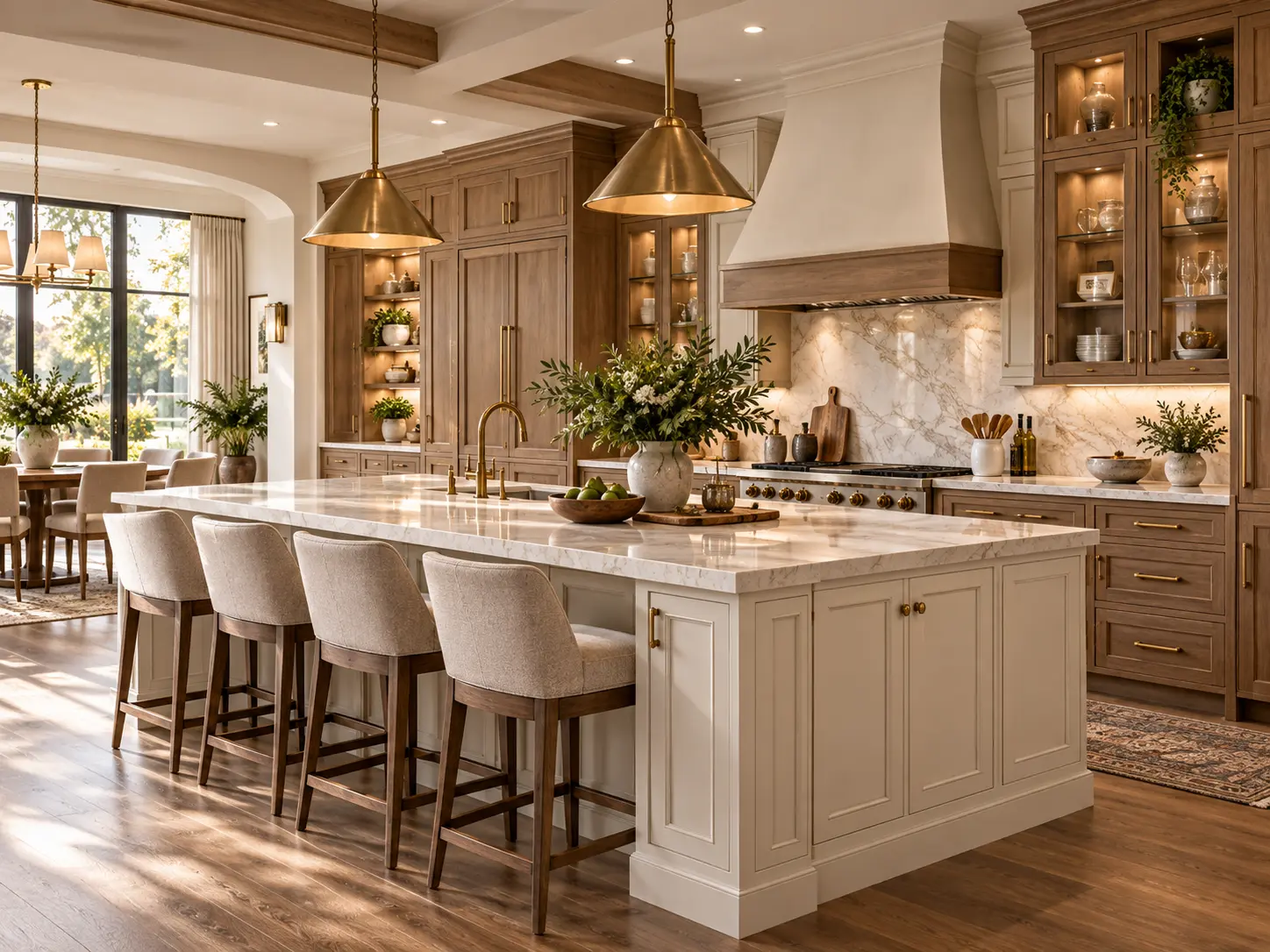
Transitional kitchens are defined by which elements lean simple and which lean detailed — there's no single correct ratio.
Borrowed from contemporary
- Simple Shaker or minimally profiled flat-panel doors
- Full overlay construction with clean, even reveals
- Slim, understated bar-pull hardware
- Quartz or simply veined countertops
Borrowed from traditional
- Furniture-style island feet or a contrasting island color
- Brass or warm-metal pendant lighting over the island
- Marble or marble-look countertops
- A wood hood surround or open shelving detail
Layout Considerations
Where the mix shows up in the room
The most common transitional layout keeps door style consistent throughout the kitchen — a Shaker profile on both perimeter and island — while shifting color or material to create contrast. A painted white perimeter with a stained wood or navy-painted island is a widely used version of this in South Florida remodels, since it lets the room stay light overall while giving the island some visual weight.
Open shelving in place of one or two upper cabinets is another frequent transitional move, especially in a kitchen that otherwise reads fairly plain — it introduces a bit of the display-oriented feel of a traditional hutch without the cost or bulk of full glass-front uppers.
Where It Fits
Transitional across Hollywood-area homes
Downtown Hollywood renovations
Many of these homes and townhomes don't carry strong period architecture in either direction, which makes a balanced transitional kitchen an easier fit than a kitchen that leans hard into a single era-specific look.
Emerald Hills and Hollywood Hills family kitchens
Larger open-plan kitchens that connect to a living or dining space often use transitional cabinetry to bridge a more traditional dining room with a simpler, contemporary living area.
Honest Tradeoffs
What to plan for
Strengths
- Flexible enough to suit a wide range of home ages and floor plans.
- Easier to update later since the base door profile stays simple.
- Room to add or dial back warmth over time through paint or hardware changes.
Considerations
- Without a deliberate contrast element, the kitchen can read as plain rather than balanced.
- Mixing finishes (wood tone, paint, metal) requires more coordination during selection than a single-style kitchen.
- Two-tone or mixed-material choices can add cost versus a single door style and finish throughout.
Style Reference
Transitional detail in context
Answers
Frequently Asked Questions
- What actually makes a kitchen 'transitional' rather than Shaker or traditional?
- Transitional is a blend rather than its own door profile — it usually pairs a simple Shaker or slightly detailed flat-panel door with one or two more traditional touches, like a furniture-style island, brass lantern pendants or a marble countertop, without the full molding and raised-panel detail of a true traditional kitchen.
- Is transitional the safest choice if I'm not sure what style I want?
- It's a reasonable middle ground because it avoids extremes in either direction, but 'safe' shouldn't mean generic — the mix of simple cabinetry with one or two warmer, more detailed elements still needs to be chosen deliberately, or the kitchen can end up looking indecisive rather than balanced.
- Can transitional cabinets be mixed with a more modern island?
- Yes, and it's one of the more common transitional layouts: a simple painted Shaker perimeter with a contrasting stained or two-tone island that leans slightly more contemporary in its hardware and lighting. The key is keeping one element — usually the door style — consistent throughout so the kitchen still reads as one cohesive room.
- What wood tones or paint colors are typical in transitional kitchens?
- Warm neutrals dominate: soft whites, warm grays, greige and pale wood tones on the perimeter, sometimes with a deeper navy, sage or walnut-stained island for contrast. Very saturated or cool-toned colors tend to push a kitchen toward a more contemporary read than transitional generally aims for.
- Does transitional work for a Downtown Hollywood or Emerald Hills remodel?
- It suits both well because it doesn't require the house to have strong period detail the way a full traditional kitchen benefits from, nor does it require the very open, minimal layout that suits pure contemporary slab kitchens best. It adapts to a range of floor plans and room ages.
- Should hardware be the same across perimeter and island in a transitional kitchen?
- Not necessarily. Many transitional kitchens use one hardware finish (often brass) throughout for consistency, while others intentionally vary the pull style — a slim bar pull on the perimeter, a cup pull or ring pull on the island — to reinforce the subtle contrast the style is built around.
Planning New Kitchen Cabinetry?
Talk through your layout, storage priorities, cabinet level and finishes before you commit to a budget.
Call now for service availability. Please have your 5-digit ZIP code ready.